Primary cycles 1 to 4
Primary school tutoring
What matters in primary school
Why tutoring matters so early in Luxembourg
Luxembourg’s primary school asks a six-year-old to do what no other European system asks: learn to read and write in a language — German — that many never hear at home, after spending cycle 1 in Luxembourgish, and before French arrives in cycle 2. Three languages before the age of ten, and a fourth at secondary school.
This creates a difficulty that doesn’t look like one. The child doesn’t say they don’t understand: they go quiet, they copy, they wait. And because everything goes through the language of the school — the maths problem, the science instructions, the test question — a reading delay shows up in every subject at once. Parents see marks falling across the board and conclude the child isn’t working hard enough.
That’s why we always start by looking at reading, even when we’re called in for maths. And it’s also why primary school is where a few hours change the most: at this age, nothing is set yet — neither the gaps, nor the idea that one is bad at school.
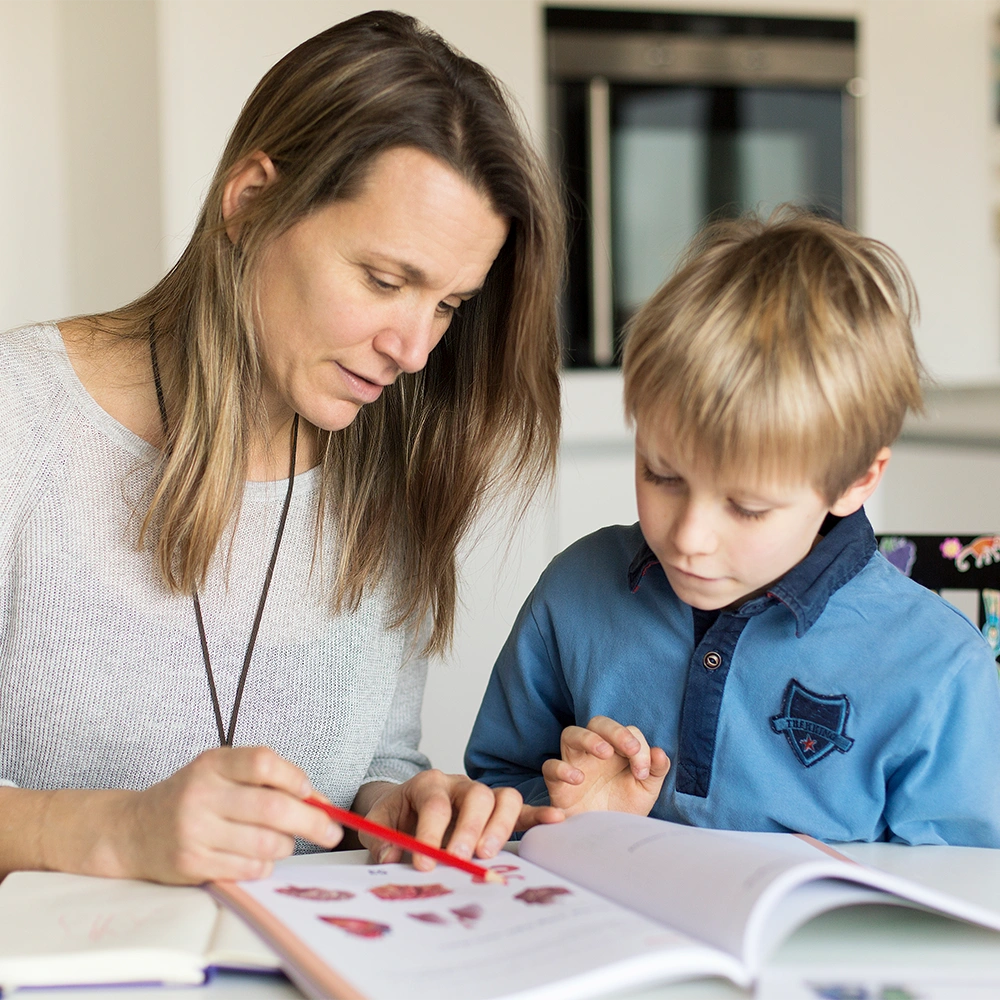
The rest is a question of rhythm: one session a week, at home, following their class curriculum and using their own exercise books. No parallel method, no extra homework. An eight-year-old who already works six hours a day doesn’t need a second school.
Subjects
What we teach primary school pupils
In primary school, a subject is never really just one subject: the maths problem is read in German, the science lesson is learned in the language of the school. So we take the class programme as it is, and we start with what is really holding things up.
Languages
- Luxembourgish lessons in primary school In cycle 1, everything happens in Luxembourgish: it’s the language of the classroom, of instructions and of the playground. A child who doesn’t hear… See the lesson
- German lessons in primary school German is the language children learn to read and write in, from cycle 2 onwards, and reading only becomes fluent with practice. Yet many… See the lesson
- French lessons in primary school French arrives in cycle 2, after German, and quickly becomes the language of many exercises. This is when good habits are formed — or… See the lesson
- English lessons in primary school English comes late in Luxembourg schooling, when three languages are already in place and pupils are starting to find that quite enough. Discovering it… See the lesson
- Spanish lessons in primary school One more language at primary school isn’t one too many when it comes through play. At this age, children don’t translate: they repeat, imitate… See the lesson
- Italian lessons in primary school Many Italian families here want the language not to be lost from one generation to the next. The child understands what the grandparents say,… See the lesson
Sciences
Better than a long speech
- 83% of our students improved their grades
- 130 qualified teachers, bachelor’s degree minimum
- 96% satisfied customers
Our teachers
How we choose your teacher
In primary school, what matters is not the highest degree: it is patience, and the ability to explain the same thing three different ways. So we look among our teachers for one who knows the cycles of primary education and can restore confidence before restoring grades.
-
Recruited after an interview and a test
A bachelor’s degree at least, and native speakers for spoken language practice. We look at the degree, of course, but just as much at the way they explain — that is what helps a student progress.
-
Chosen for your situation
Before the first lesson, we assess the level and the goal, then look in our team for the matching profile — school, section and language of instruction included.
-
Followed up, and replaceable
An adviser reviews progress with you every four to six weeks. If you don’t get on, you can change teacher whenever you ask — no reason needed and at no cost.
Our prices
-
For you
Primary
55€
per hour, at home
Online from €49
- Reading, writing, arithmetic and German
- At the pace of the class programme
- A teacher who knows the Luxembourg system
-
For you
Secondary
55€
per hour, at home
Online from €49
- Classic, general and international schools
- Every subject in the programme
- Preparation for the end-of-school exams
-
For you
Adults
59€
per hour, at home
Online from €49
- From complete beginner to advanced
- At home, at the office or by video call
- You decide how many lessons
-
For you
Companies
On quotation
depending on the number of participants
- At your premises, on site or by video call
- Content drawn from your teams’ work
- Level assessment at the start, then regular reviews
- Tax credit of 20% to 35%
Prices include VAT, with no registration fees and no minimum commitment. The first contact and the choice of teacher are free.
Customer reviews
What our students say
The reviews shown come from our Google page or were sent to us directly: the name, rating and date are those of the review, and we never rewrite any of them. The overall rating is Google’s – it takes every review into account, including the less favourable ones. How we collect our reviews
4.8/5 23 Google reviews
Read them on Google (opens in a new tab)
I contacted Cours At Home to take Luxembourgish lessons. The lessons are tailored to what we ask for, and scheduling lessons with the teacher is very flexible. I really recommend it, I’m very satisfied.
This language school is great and the staff really listen. Jérôme Koenigsecke, who runs it, is always fully available and will answer all your questions. Liliana (Luxembourgish teacher) is very caring and teaches with exemplary skill.
I am very happy with Cours at Home’s services. I have been using them for a little over three years now, and I can confirm that their service is excellent. Cours at Home always listens to its clients’ needs – needs which, in my case, are rather demanding, since I am usually looking for German-speaking teachers.
I took German and Luxembourgish lessons with Cours at Home and I’m very satisfied. The lessons are well structured and tailored, and the trainers are good teachers. It really helped me progress. I recommend them without hesitation.
The German lessons with Aurore make for real learning, with lots of speaking practice, interactive lessons, good teaching methods and plenty of variety. I recommend her 100%. The lessons are well organised, with flexible options.
Frequently asked questions
What people ask us most
Have a question? Call us now
+352 26 30 27 90From what age do you take children?
From cycle 1 through to the end of primary school. Before the age of six, we talk about early learning rather than tutoring: sessions last half an hour, are built around games and nursery rhymes, and look nothing like a lesson. It’s the only format that works at that age.
My child has poor marks in every subject. Where should we start?
Often with none of the ones we’re told about. When marks drop in every subject at the same time, it’s almost always reading that’s the problem: the child doesn’t understand the question, not the subject. The first lesson is used to check this, and everything else follows from it.
Are lessons taught in the language of the school?
Yes, and it matters: a child who does maths in German gains nothing from revising it in French — they would learn vocabulary they won’t see on their test paper. Tell us the school and the cycle, and we’ll match you with someone who knows them.
Does the teacher set extra homework?
No. A primary school child already works six hours a day, and a second school would only tire them out. The teacher works on what the class requires — the day’s homework, the week’s lesson, the upcoming test — at the child’s own pace.
How long before we see results?
What changes first isn’t the mark, it’s the attitude: a child who opens their exercise book without being asked, who raises their hand in class. That often happens within a few weeks. The marks follow, but with the delay of the test calendar — and we don’t promise a date.

A teacher within 72 hours
Tell us the subject, the class and the goal. We find the teacher, you choose the time slot — with no commitment.